

Home News & Events
Green AI conference opens at Dubai Police Academy to a full house
Dubai, UAE, 24 January 2026: The 1st Dubai International Conference & Exhibition on Green Artificial Intelligence for a Green Planet (DICEGAI 2026) opened today at the Dubai Police Academy, bringing together a packed audience of academics, environmentalists, researchers, media, sector professionals, educators, and students for a full day of thought leadership and applied discussion. With strong participation from across the sustainability and technology ecosystem, Day 1 set an energetic tone around how Green AI can be developed and deployed responsibly to support environmental priorities while strengthening public trust, governance, and long-term impact.
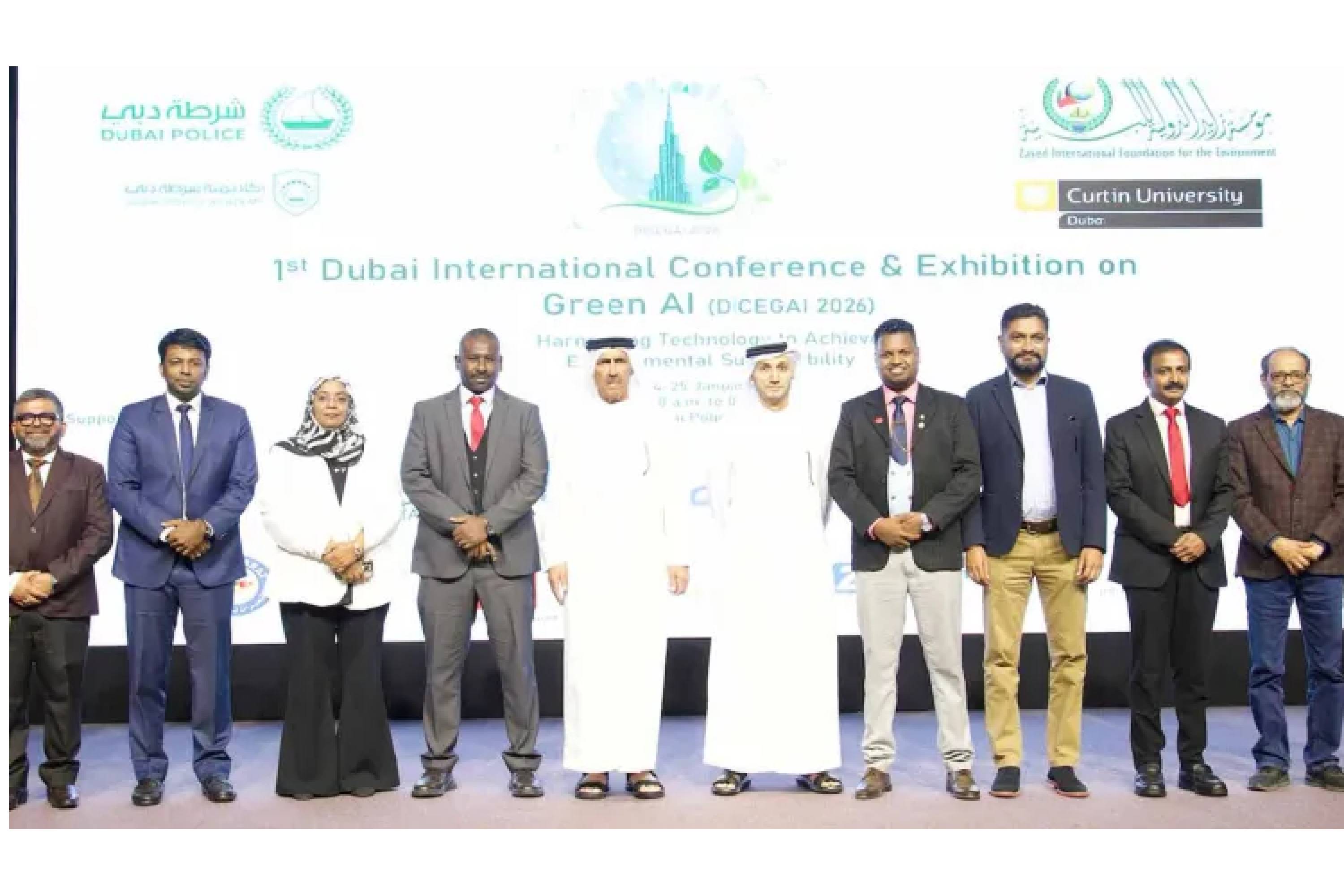
The Day 1 opening programme began with the National Anthem as the event commenced under the patronage of H.E. Lieutenant General Abdalla Khalifa Al Marri, Commander-in-Chief of Dubai Police, reflecting the conference’s emphasis on aligning advanced technologies with societal benefit, security, and responsible practice. Opening remarks were delivered by Prof. Ammar Kaka, Pro Vice Chancellor, Curtin University – Dubai, Dr. K. Anand, Managing Trustee, Adishankara Engineering Institute, India, and Prof. Dr. Mohammad A. Bin Fahad, Chairman of the Zayed International Foundation for the Environment, underscoring the value of cross-sector collaboration to translate research, policy, and innovation into practical outcomes.
Reflecting the growing momentum around sustainability-driven AI, the Day 1 audience represented a broad, relevant cross-section: environmental and sustainability stakeholders, engineers and technologists, governance and policy-minded participants, educators, and a visible cohort of students intent on shaping the next chapter of responsible innovation. The scale and diversity of attendance reinforced the conference’s core premise that Green AI is not a niche domain, but a shared agenda that demands credible standards, real-world implementation pathways, and transparent decision-making across institutions and industries.
The keynote sequence then moved directly into the critical intersection between innovation and resilience. A keynote presentation on AI & Cybersecurity delivered by Dubai Police positioned secure-by-design thinking as an essential foundation for scaling AI across sensitive and high-impact environments. Building on this, Dr. Anwar Dafa-Alla, President of the Sudanese ICT Professionals Association in Qatar (SIPAQ), delivered a focused address on the importance of AI and its challenges, emphasising practical considerations that decision-makers must confront to ensure AI deployments remain accountable, robust, and aligned with intended outcomes.
The morning continued with a strategic environmental perspective delivered by Prof. Pon Selvan, John Curtin Distinguished Professor and Director of Engineering & Science, Curtin University Dubai, who addressed current global environmental issues and challenges. His remarks connected technology choices to the wider pressures shaping sustainability priorities globally, reinforcing that meaningful progress requires both scientific seriousness and operational pragmatism. This flow of security, governance realities, and environmental context gave Day 1 a clear structure: Green AI must be safe, purposeful, and designed to produce measurable benefits without creating new risks or unseen costs.
Following these opening proceedings, the programme included a formal moment to honour partners and sponsors, recognising the role of sustained collaboration in advancing applied research, convening expertise, and supporting ambitious programmes at scale. The recognition segment reflected the conference’s emphasis on shared ownership where progress depends not on one stakeholder group, but on coordinated contributions from institutions, experts, and supporters committed to responsible innovation. This tone of partnership carried into the rest of the day’s sessions, reinforcing a common objective: accelerate Green AI, but do so with governance, accountability, and clear real-world value.
A central highlight of Day 1 was the session on AI Ethics & Governance, chaired by Dr. Hamdan K. Al Shaer, Deputy Chairman of the Zayed International Foundation for the Environment. The session addressed the practical question many organisations face: how to make ethical AI actionable for leaders and operators rather than a purely theoretical aspiration. It emphasised governance as an enabling discipline clarifying accountability, strengthening oversight, and ensuring that environmental intent is matched by operational controls, transparency, and defensible decision-making throughout the AI lifecycle.
Speakers in the Ethics & Governance session delivered complementary perspectives that kept the discussion grounded and decision-oriented. Nader Torki presented “Ethical AI for Decision Makers,” focusing on how leadership teams can translate principles into governance, risk discipline, and day-to-day decisions. Dr. Joseph K Thomas presented “Green AI and the Future of Our Planet,” connecting sustainability ambitions to the practical choices that shape AI’s environmental footprint and societal value. Sarath Kumar Pachayil presented “Green AI and Red AI: Two Divergent Paths of Artificial Intelligence Development,” prompting a robust exchange around priorities, trade-offs, and the consequences of building AI without clear ethical and environmental guardrails.
The afternoon programme transitioned into the built environment, chaired by Dr. K. Anand, sharpening the conference’s focus on implementation and scale. This segment highlighted how Green AI can influence design, engineering, operational efficiency, and circularity areas where improvements can compound across infrastructure and supply chains. Speakers examined how to engineer sustainability outcomes into algorithms and systems from the outset, and how to ensure that AI applications remain transparent, traceable, and aligned with wider environmental performance objectives rather than limited, short-term optimisation.
Presentations in the built environment session showcased applied pathways from design principles to scalable systems. Dr. Mazin Ghadir presented “Green Algorithm and Sustainable AI Design,” exploring how efficiency and sustainability can be embedded at the algorithmic level. Eng. Shwan Al Hashimi presented “Zero-128-Zero: Resonance of Persistent Algorithms,” highlighting approaches to resilient performance and persistence in algorithmic systems. Gowri Shankar presented “Digital Product Passports (DPP): Using AI to Trace, Sort, and Recycle at Scale,” demonstrating how AI-enabled traceability can strengthen recycling outcomes and advance supply chain accountability.
Day 1 concluded with open discussion and closing, bringing the day’s themes into a unified message: Green AI is most credible when it is secure, governed, and designed for measurable environmental benefit. Across keynotes and sessions, DICEGAI 2026 emphasised that progress depends on disciplined governance, responsible engineering, and broad stakeholder participation including the next generation of practitioners and researchers. The conference continues tomorrow with further discussions and engagements advancing the shared objective of harnessing technology to achieve environmental sustainability.